
Monthly Archives: January 2016
7 Deadly Sins?
Tradition holds that there are 7 “deadly” sins, including Lust, Envy, Anger, Pride, Greed, Gluttony, and Sloth. However destructive these seven sins are, the scriptures speak of a particular “sin unto death”, for which there is no absolution…
In the Holy Scriptures, both Christ (Mark 3:29) and St. John the Apostle (1 John 5:16) spoke of a “sin unto death” for which there was no forgiveness …Christ described this act as “blasphemy against the Holy Ghost” (Mark 3:29). This might seem vague at first, but upon further study one will come to understand that the Holy Ghost is the Spirit of God that communicates with man (1 John 3:19; 24). It is the Spirit of Truth and the voice of all that falls within that realm (Truth is not fact or the sum of facts, but something that exists beyond the realm of fact); it is a voice that speaks deep within our hearts and instructs the soul. One might liken it to the tie that binds mother and child, man and nature…these are not facts that need to be proven, but things we “know” if we surrender to this voice, this Spirit that “bears witness” to that which is Holy and True. While understanding who the Holy Ghost is what He does explains part of what Christ meant, there still remains the issue of what exactly constitutes “blasphemy” against this Spirit…St. Paul, the apostle responsible for penning the bulk of Christian doctrine (under the divine inspiration of this same Spirit of Truth), sheds further light on what Christ was referring to. Looking into this further we find that what Christ was referring to was the essence of salvation.
Much like the popular TV game show Jeopardy, Christ’s statement concerning the unpardonable sin was an answer to something St. Paul would write later. St. Paul’s question was “How shall we escape if we neglect so great salvation?“ (Hebrews 2:3). Christ’s answer was simple- we can’t. When a person is faced with the question of Christ – who He was (the Son of God) and what He did (offering Himself as the final sacrifice for human sin through His death on the cross and the promise of eternal life through His resurrection) – the Spirit of Truth, that voice deep within the heart will confirm the truth of Christ’s identity and our need for His salvation. To close your heart to this confirmation, to harden your heart against this conviction is to commit blasphemy against that Spirit that God has provided to every person regarding the question of Christ.
There are only 2 choices offered to men regarding Christ: acceptance and rejection. This is symbolized by the two thieves crucified alongside Christ. These two men were identical except for their response to Christ’s suffering… one refused to believe and hardened his heart; the other simply opened his heart and asked for salvation, to which Christ replied “this day shalt thou be with me in paradise.” There are only two choices offered to men regarding the voice of Truth: belief or blasphemy. Christ said that “He that believeth on the Son hath everlasting life: and he that believeth not the Son shall not see life, but the wrath of God abideth on him” (John 3:36). As in the fashion previously described, St. Paul further clarified what Christ meant when he wrote; “For with the heart man believeth unto righteousness and with the mouth confession is made unto salvation” (Romans 10:10).
With all the stress and bustle of modern day life it is all too easy to neglect the salvation Christ offers. We need to take the opportunity to contemplate the events that took place on that mountain outside Jerusalem some 2000 years ago and soften our hearts to that voice of Truth and believe that Christ was who he claimed to be. We need to, in own words, confess our sins in prayer to Him and ask to partake of the salvation He freely offers to us. While we may, as humans, be guilty of the most unspeakable cruelties and errors, it will not be for these sins that God the Father sentences any one of us to eternal damnation; it will be for the unforgivable sin of rejecting his Son and the sacrifice He willingly made for each of us on the cross.
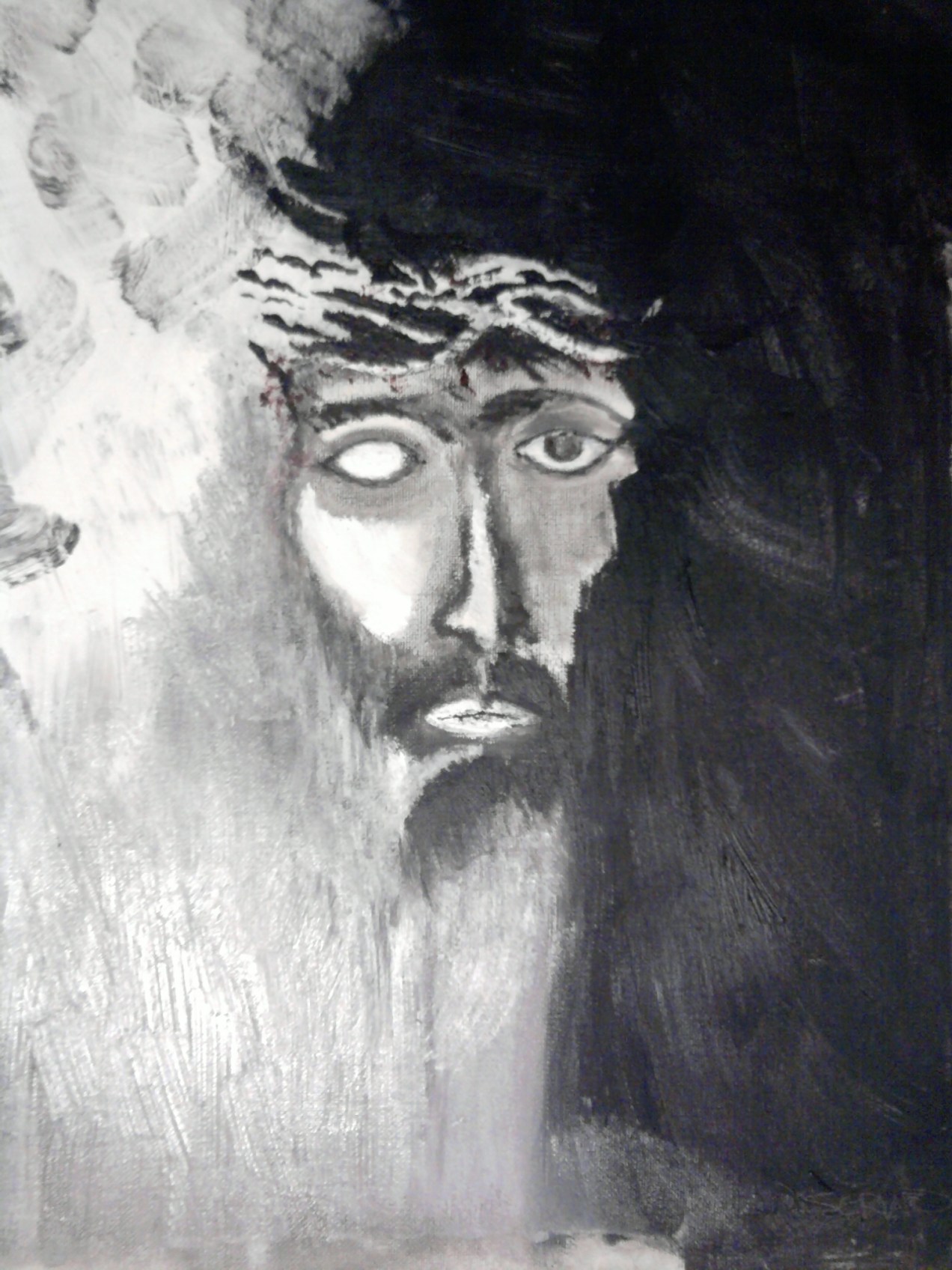
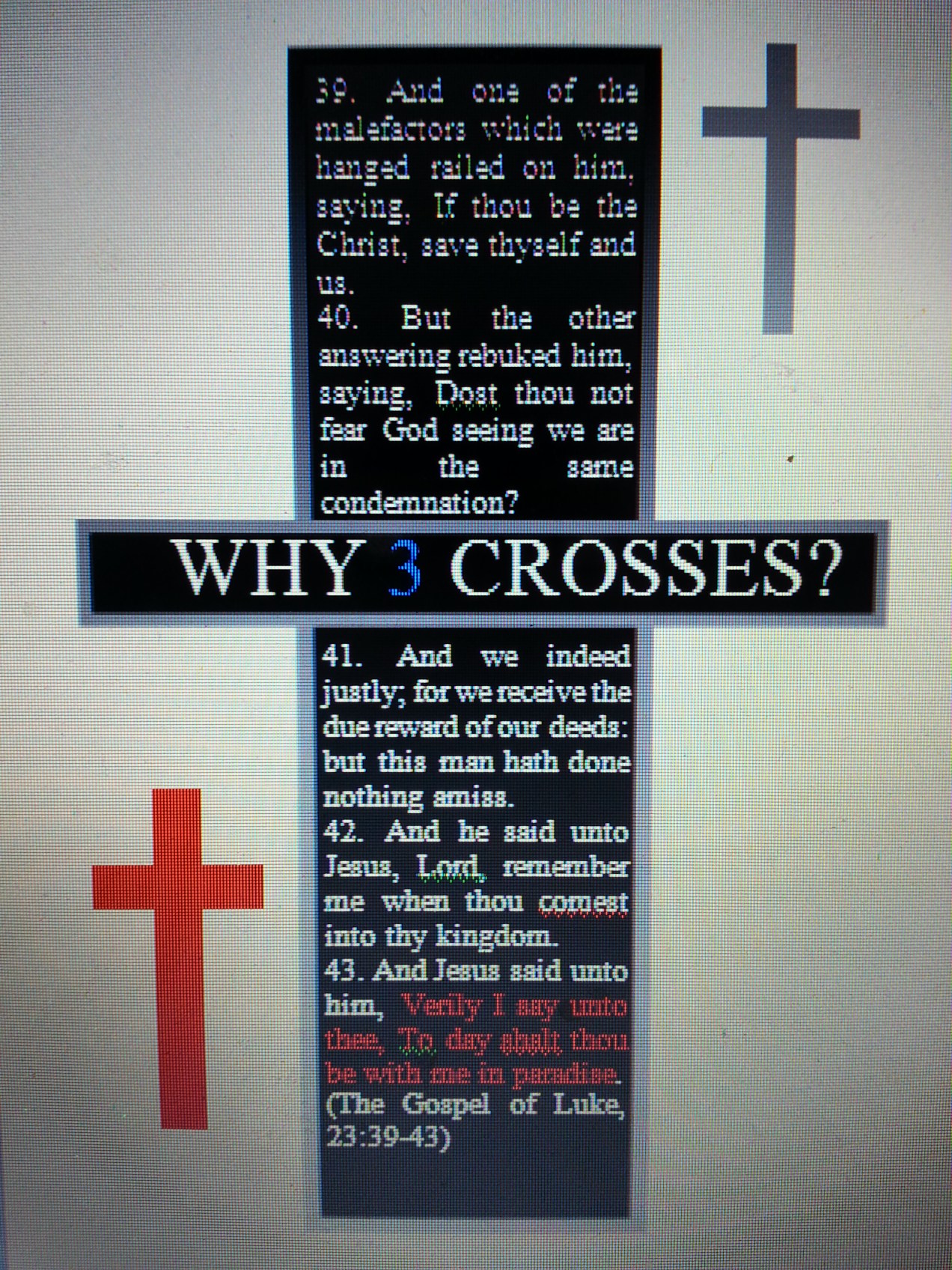
Why 3 Crosses?
Stop for a moment, if you would, and consider this question. Why 3 crosses? Why would God allow the spectacle of his Son’s death, the greatest event in recorded history, to take place between the crosses of 2 other men? Why was Jesus Christ not lifted up alone as He suffered? Given the innocence of His soul, the uniqueness of His life, and the Holy paternity of Jesus, why would God will it that He be crucified with 2 men who (unlike Jesus) were guilty and deserving of their punishment according to the law? The answer to these questions can be found in the scriptural account of what took place between Christ and these 2 convicts on that mountain outside Jerusalem some 2000 years ago.
For the sake of argument, let us take Christ at His word (according to first-hand accounts given in the Scriptures by men who walked, talked, ate, and worked with Him) and accept that His death was the only means by which every person’s sentence of eternal death could be transformed into eternal life. This alone does not explain the need or reason for the 2 (and only 2) other men crucified alongside Christ. Even if we accept that salvation was accomplished through Christ’s death on the cross and forever sealed by his resurrection 3 days later, we are still left with the 2 men that fate (God) saw fit to place on either side of Christ. The fact that there were 2 convicts serving their sentences alongside Christ indicates dichotomy, an either-or situation; a “crossroads”, if you will. Aside from the number 2, additional clues that we have in regard to the significance of these 2 convicts are found in the similarities and distinctions that are drawn between these 2 men in the Scriptures (John 19; Luke 23, Mark 15, Matthew 27).
Similarities
- They were both condemned to death.
- They were both deserving (guilty as charged) of their sentence.
- They were both aware of who Christ claimed to be and were witnesses to his suffering and death. They both participated with the crowd in mocking and rejecting Christ.
Differences
- They were not together on 1 side, behind, or in front of Christ, but 1 on either side with Christ in the middle. (As described by in the above accounts.)
- Only 1 accepted his punishment as just. (Mark 15)
- Only 1 believed Christ’s punishment as unjust. (Mark 15)
- Only 1 repented of his part in the mocking and rejection of Christ and voiced this change of heart to Christ by believing Christ was who He said he was (God’s son, the Messiah ) and requesting that Christ (as God’s Son) grant him forgiveness and a place in heaven (Christs’ future kingdom). (Mark 15)It is important that we understand that we, as human beings, share in the above similarities. The Scriptures clearly state this:
- Condemnation: And it is appointed unto men once to die, and after this the judgment. (Hebrews 9:27); for the wages of sin is death…(Romans 6:23);
- Guilt: …they are all under sin; As it is written, there is none righteous, no not one. (Romans 3:9,10); …and so death passed upon all men, for that all have sinned: (Romans 5:12)
The Cause of Christ’s Suffering and Death: But he was wounded for our transgressions (crimes), he was bruised for our iniquities (sins): the chastisement (punishment) of our peace was upon him; and with his stripes we hare healed. (Isaiah 5:10); Jesus our Lord…Who was delivered for our offences (crimes) and raised again for our justification (pardon). (Romans 5:25). The other important information that we have in regard to identifying who (and / or what) these 2 convicts symbolize is found in the Scriptural accounts of God’s position on man’s fate in the next life. Interestingly enough, the Scriptures clearly show that God describes only 2 fates for human beings in the next life:
Eternal Damnation: …this is the second death. And whosoever was not found written in the book of life was cast into the lake of fire. (Revelation 20:15) …he that believeth not shall be damned. (Mark 16:16) Verily, verily (Truly, truly) I say unto you, he that believeth on me shall have everlasting life. (John 6:47)
Then shall he say unto them on the left hand (refers to those at the judgment who Christ does not recognize as His own), Depart from me, ye cursed, into everlasting fire, prepared for the devil and his angels…And these shall go away into everlasting punishment. (Matthew 23:41, 46)
- …and he that believeth not the Son shall not see life, but the wrath of God abideth (stays) on him. (John 3:36)
For God sent not his Son into the world to condemn (damn) the world, but that the world through Him might be saved. He that believeth on Him is not condemned: but he that believeth not is condemned already, because he hath not believed in the name of the only begotten Son of God. (John 3:17,18)
And I saw a new heaven and a new earth…And the city had no need of the sun, nether of the moon to shine in it, for the glory of God did lighten it, and the Lamb (Jesus) is the light thereof…And there shall in no wise enter anything that defileth (pollutes) …but they which are written in the Lamb’s book of life. (Revelation 21:1, 23, 27)
According to the facts we’ve encountered, reasoning and understanding allow us to draw these conclusions about who and what the 2 convicts represent:
There are only 2 kinds of people in this world.
There is only 1 meaningful difference between these 2 kinds of people, and that difference is where they stand in relationship to Christ and his death and resurrection.
There are only 2 positions that one can hold in regard to Christ and those 2 positions correspond to the 2 fates that await every person in the next life.
Eternal Salvation – Represented by the convict who:
- Accepted his guilt and turned his heart from disbelief to faith
- Confessed this change of heart in his own words and professed his belief directly to Jesus by asking to partake of the salvation Christ offered.
- Eternal Damnation – Represented by the convict who:
- Refused to be penitent and contrite concerning his state
Refused to believe that Jesus was the Christ, the 1 and only source of redemption. As human beings we, like the 2 convicts, hang upon the cross of mortality with a choice to make; the time we have been given to make this choice grows shorter with every hour, every minute, every second. Having heard the story of Jesus and knowing who (God’s Son) and what (the Lamb of God which taketh away the sin of the world) He claimed to be, we must choose to receive or reject, accept or deny, to look upon Him with a heart of faith or to harden our hearts in disbelief. Choosing not to decide is still making a choice, a choice that we are only given so long to make. Would you follow the penitent convict’s example and admit your condition as a sinner in need of a savior? Would you believe upon the name of the only begotten Son of God, Jesus Christ, and would you confess your need and profess your faith to Him in your own words? If you will, He has promised to receive you and to speak for you before the Father at the last day – a promise He earned the right to offer and keep with His own life and blood, and with His resurrection. Will you not ask of Him? Can you not trust in Him? If not Him, then who? If not now, then when?
If we accept the metaphor shown by the 3 crosses, we arrive at a very personal and difficult question…
Which of these two convicts am I represented by?
If you would come to Him, simply follow the example of the penitent convict –
Accept your guilt before God and your need of a savior; Believe with your heart that Jesus was who He said He was, and that He alone can provide salvation;
Confess to Christ (through prayer in your own words) your need and your desire to be pardoned through His sacrifice on the cross; voice to him your faith that He (through His resurrection) has the power to save and keep your immortal soul.
Remember, He has promised that He will receive all who choose to come to Him.
 3treehilldotorg